Steelborn: Tank Idle RPG
- 4.1
- Rating
- 10.00K
- Installs
- Free
- Price
 Analysis by App-foxy
Steelborn: Tank Idle RPG caught my attention because it combines a very specific fantasy with a compact mobile format: you build a warrior tank, improve it, and send it into PvP battles. That idea sounds simple, but the appeal depends on how well the game turns upgrades, visual style, and battle timing into a satisfying routine. After spending time with it, I see it as a role-playing game for players who enjoy making steady progress and testing a customized machine against other opponents without committing to a long traditional campaign.
My first impression was that the game wants to feel more like a personal workshop and battle arena than a huge open-world adventure. The focus stays close to the vehicle and its growth. That gives the experience a clear identity, although it also means players looking for a deep story, a large exploration map, or a highly technical simulator should adjust their expectations. The strongest reason to try Steelborn is the loop of preparing a tank, entering a fight, learning from the result, and refining the build.
A focused entry point into tank-based role-playing
The game is free to download and is developed by SayGames Ltd. It sits in the role-playing category, but its role-playing side is expressed through building and improving a combat vehicle rather than controlling a conventional hero walking through a fantasy world. That distinction matters. The main question is not whether you enjoy character dialogue or quest chains; it is whether you like watching a combat unit become more capable through repeated upgrades and decisions.
You May Also Like

 AccuWeather: Weather Radar
AccuWeather Review: A Quick, Clear Forecast for Everyday Decisions
For everyday plans, the best forecast is the one you can understand quickly. AccuWeather makes rain timing, radar, and local conditions easy to act on, with a few trade-offs.

 Hill Climb Racing
Why Hill Climb Racing Still Turns Crashes Into One More Run
A tiny car, a bumpy hill and one more upgrade: Hill Climb Racing keeps resurfacing because its simple chaos makes every near-miss feel personal.

 AliExpress - Shopping App
AliExpress Makes Global Shopping Feel Personal, but Shoppers Bear the Risk
AliExpress turns a global marketplace into a pocket-sized discovery engine. Its reach is useful, its shopping loop compelling, and its trade-offs easy to miss.

 Lords Mobile: Kingdom Wars
Lords Mobile Is a Kingdom-Building Routine, Not a Quick Match
A case-by-case verdict on the building, battles, device demands, and social commitments that make Lords Mobile rewarding for some players and exhausting for others.

 PDF Scanner app - TapScanner
TapScanner Makes Paperwork Easier to Capture, Check, and Share
TapScanner makes scanning with a phone feel less like a rescue operation and more like a dependable step in getting work done. Its capture tools are useful, though not flawless.

 Block Blast!
 Shows How Much a Puzzle Game Can Leave Out
A quiet grid game shows why puzzle players increasingly value instant clarity, repeatable skill and low-pressure play—and where the genre still needs to catch up.
More From Our News Desk
View All News


Steelborn: Tank Idle RPG is rated for Everyone, which makes its presentation approachable for a broad audience. The current version is 1.1.1 and it runs on Android 8.0 or later. Those details make it a practical option for people using an older compatible phone, though the actual comfort of play will still depend on the device and how well it handles the game during longer sessions.
The store shows a 4.1 average from around 1.1 thousand ratings, with over 100 written reviews and more than 10 thousand installs. That gives the game an early, modest footprint rather than the feel of an enormous established community. I would treat that as a reason to approach it as a focused title that is still finding its audience, not as a guarantee that matchmaking or long-term competition will feel equally active for everyone.
In everyday use, I can imagine opening it during a short break, checking the tank’s progress, making one useful improvement, and playing a few arena matches before putting the phone away. It is less suited to someone who wants one uninterrupted evening of story-driven role-playing. The compact structure is convenient, but it can also make the experience feel repetitive if the upgrade decisions do not remain interesting over time.
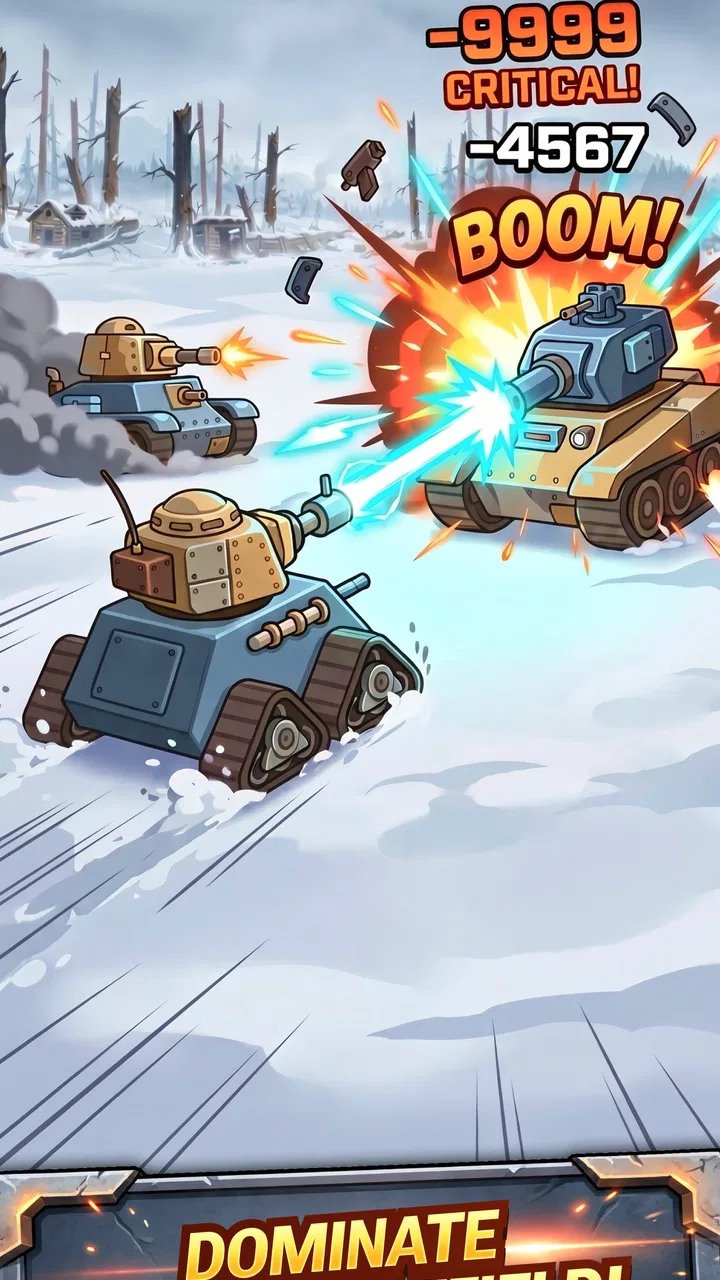
The visual language makes the machine the main character
The art direction works best when it treats the tank as more than a disposable unit. A warrior tank has a built-in personality: it is heavy, mechanical, and aggressive, yet it can still reflect the choices made by its owner. That framing helps the game avoid feeling like an anonymous collection of menus. Every improvement has more meaning when I can connect it to the identity of the vehicle I am building.
The setting is deliberately narrow. Rather than asking me to absorb a complicated mythology, the game communicates its world through the contrast between armored machinery and the arena. That is a sensible choice for a mobile title with a PvP focus. The visual idea is easy to understand immediately, and the lack of unnecessary world-building keeps attention on the battle preparation and the opponent.
This approach also creates a useful trade-off. A concentrated setting can feel coherent, but it leaves less room for surprise. Players who love discovering new regions, meeting a large cast, or uncovering a layered narrative may find the atmosphere too contained. I would choose this game for its industrial combat mood, not for storytelling depth.
One practical tip is to judge upgrades by how they support the role you want the tank to play, rather than treating every improvement as equally valuable. Even without turning the game into a spreadsheet exercise, it helps to decide whether you are trying to survive longer, finish fights faster, or create a more balanced machine. That simple intention gives the visual customization and progression a clearer purpose.
Atmosphere comes from restraint rather than spectacle
The mood is strongest when the game keeps the arena, the tank, and the next opponent in the foreground. A focused presentation can make short sessions feel purposeful. I do not need to remember a large cast of names before a battle; I can concentrate on what my machine is becoming and whether the latest change actually improves the way I approach a match.
That restraint is also why the game may appeal to people who normally avoid role-playing games with too many systems. The tank provides a clear anchor. Instead of managing an entire party with several characters and overlapping abilities, I can think about one central combat identity. For a new player, that makes the first steps easier to understand.
The downside is that a single-machine focus can expose repetition quickly. If the arena encounters and upgrade choices begin to feel too similar, the compact presentation has fewer distractions to compensate. My advice is to play in deliberate sessions: make a change, test it, and stop when the next match feels like a reflex rather than a decision. That keeps the progression loop from turning into background tapping.
Sound and rhythm shape the short-session experience
The audio direction has an important job in a tank game. Mechanical movement, impacts, and battle cues can make a modest encounter feel weighty, while a weak soundtrack would make the same actions feel flat. I found that the sound works best as support for the machine-focused mood rather than as the main attraction. The game’s identity comes from the armored setting and the arena loop, with audio helping those moments feel connected.
Rhythm is particularly important because the title combines idle-style progression with active PvP. Those two ideas can pull in different directions. Idle systems suggest patience and gradual accumulation, while arena combat suggests immediate attention and competition. The experience feels most comfortable when I use the idle side to prepare for a battle and the active side to evaluate whether that preparation was worthwhile.
This creates a useful everyday pattern. I might check progress while waiting for a bus, then save a proper match for a moment when I can pay attention. That separation prevents the passive elements from making the battles feel meaningless. It also gives the game two different types of engagement: a quick maintenance visit and a more focused competitive session.
Players who need constant action may find the idle rhythm too slow between meaningful decisions. On the other hand, people who enjoy watching a build develop may appreciate not having to fight continuously to feel progress. The best fit is someone who likes alternating between small management choices and short bursts of arena play.
Where the mechanics feel coherent
The central mechanical fit is clear: build a warrior tank, improve it, and bring it into PvP. That loop connects the role-playing label to the combat setting in a natural way. Progression is not separate from the fantasy; it is the fantasy. I am not merely unlocking abstract numbers, but shaping the kind of armored fighter I want to take into battle.
The most useful way to approach the system is to treat every match as feedback. If a tank loses because it cannot stay effective long enough, the next improvement should address that weakness rather than simply adding power in an unrelated area. If it survives but cannot close out an opponent, a more offensive adjustment may make sense. This kind of cause-and-effect thinking is more rewarding than automatically selecting the most expensive-looking option.
That is also where the game differs from many conventional mobile RPGs. A party-based role-playing game asks me to balance several characters, roles, and abilities. A character-collector title may focus on gathering a wide roster. Steelborn keeps the spotlight on one tank, so the satisfaction comes from tuning and testing a central build instead of assembling a large team.
The trade-off is variety. A single tank identity is easier to follow, but it may not offer the same experimentation as a roster full of heroes. If you enjoy comparing many characters or changing team compositions every few minutes, another role-playing game will probably provide more variety. If you prefer seeing one machine gradually become your own, this tighter structure is a strength.
There is another important consideration: PvP changes how I evaluate progress. In a purely solo game, an upgrade can feel good simply because it makes the next stage easier. Against other players, improvement has a competitive context. A build that looks powerful in isolation may still struggle against a different approach. I would therefore avoid spending resources immediately after a frustrating loss. First identify whether the problem was the build, the matchup, or a rushed decision, then make one controlled change and test again.
Free entry, but spending deserves attention
The game is free, which makes it easy to try without an upfront purchase. It includes in-app purchases ranging from $0.99 to $299.99 per item. That is a wide range, so I would recommend deciding on a personal spending limit before getting deeply involved in progression. The low-cost options may feel harmless in isolation, but repeated purchases can change the way a supposedly free game fits into a monthly budget.
For me, the right question is whether the game remains enjoyable when I play at my own pace. If the pleasure comes from making thoughtful improvements and learning from battles, spending should be optional rather than the reason to continue. Players who dislike any form of purchase pressure should be cautious, especially in a PvP setting where progression can feel more urgent than it would in a solo adventure.
A sensible workflow is to play long enough to understand the basic progression before buying anything. First learn what kind of tank you enjoy, then see which improvements actually change your results. That prevents an early purchase from locking you into a style you do not like. It also makes it easier to tell whether you are paying for convenience or simply chasing a temporary advantage after a loss.
Who will enjoy the arena loop most?
Steelborn: Tank Idle RPG is a good match for players who like short competitive sessions, visible progression, and a strong mechanical theme. It suits someone who wants a game that can be checked briefly but still offers a reason to return for a more involved battle. The tank-centered design is especially appealing if you prefer building one recognizable combat machine instead of managing a large collection of heroes.
It is also a reasonable choice for a newcomer to mobile role-playing games. The central fantasy is easy to understand, and the arena gives progression a clear destination. You do not need to learn a giant fictional universe before making your first meaningful decision. The game can function as a lighter alternative to more demanding RPGs that require long sessions or extensive roster management.
I would skip it if your main priority is a rich narrative, exploration, or deep party tactics. It is also not the right choice if you want a completely relaxed experience with no competitive pressure. PvP naturally encourages comparison, and the idle structure may feel slow to players who want every minute to contain direct action.
For families, the Everyone rating makes the game broadly accessible in terms of content. Still, I would explain the purchase system to younger players before handing over a device. The age rating describes the content, but it does not remove the need for sensible boundaries around optional spending.
Small habits that make the progression more satisfying
The first useful habit is to keep a simple mental record of what caused a defeat. Was the tank overwhelmed early, or did the battle drag on until it lost momentum? Those are different problems and should not lead to the same upgrade choice. This approach turns losses into information instead of making every defeat feel like a reason to spend immediately.
The second is to avoid changing several things at once. If I upgrade multiple aspects of the tank before returning to the arena, I may win but learn nothing about which decision mattered. One targeted adjustment gives a clearer sense of cause and effect. That is especially helpful in a game where the appeal comes from building a machine that feels deliberately shaped.
The third is to separate progress checks from serious matches. A quick visit is perfect for checking the tank and handling a small task, while a competitive battle deserves a few uninterrupted minutes. Mixing the two can make the game feel more hurried than it needs to be. The idle layer is most useful when it prepares the next decision, not when it replaces decision-making altogether.
Finally, I would compare the value of an upgrade with the amount of play it unlocks for you. A purchase or improvement that only makes the next few minutes easier may be less satisfying than one that supports a style you plan to use repeatedly. This is not about finding a universal best build; it is about making sure the tank’s development matches the way you actually enjoy playing.
How it compares with familiar mobile RPG alternatives
Compared with a traditional turn-based RPG, this game is more immediate and less character-focused. There is less emphasis on reading a long story or arranging a full party, and more emphasis on the relationship between one machine and the arena. That makes it easier to pick up, but potentially less rewarding for players who enjoy elaborate tactical layers.
Compared with an action-heavy tank game, it places more weight on progression and preparation. The tank is not only something I steer or fire; it is the result of accumulated choices. The trade-off is that the moment-to-moment action may not satisfy someone who wants constant manual control and highly detailed combat physics.
Compared with an idle RPG built around heroes, the mechanical theme gives Steelborn a more distinctive mood. A tank can feel like a project, and that makes upgrades easier to interpret. However, the narrower identity may offer less variety than a game built around many classes, characters, and abilities. Choosing between them comes down to whether you prefer depth around one machine or breadth across a large collection.
My final view of the atmosphere and the loop
What I like most is the coherence between the setting and the mechanics. The armored visual identity, the arena structure, and the gradual improvement loop all point in the same direction. The game does not need a huge world to communicate what it wants me to do: build something tough, take it into battle, and learn from the result.
Its limitations are equally clear. The focused design may become repetitive for players who need constant novelty, and the idle progression can feel too passive when I am in the mood for uninterrupted action. The presence of purchases, including high-priced individual items, also means I would approach the game with a spending boundary rather than treating every shortcut as harmless.
Overall, I recommend Steelborn: Tank Idle RPG to anyone who enjoys a compact tank-building RPG with PvP at its center and a restrained industrial mood. I would not recommend it as a substitute for a story-rich role-playing adventure or a full manual tank simulator. But if you want a free game that lets you shape one armored fighter, test it in the arena, and return later to improve the design, it has a clear and appealing purpose.
My advice is to start slowly, identify the kind of tank you enjoy, and let your match results guide your next decision. When played that way, the game’s atmosphere and mechanics support each other: the tank feels like a personal project, the arena gives it a reason to exist, and each return visit has the potential to answer one practical question about how your build performs.
FAQs for Steelborn: Tank Idle RPG
01What is Steelborn: Tank Idle RPG about?
Steelborn: Tank Idle RPG combines idle progression, tank combat, and role-playing elements in a post-apocalyptic setting. You build and upgrade a powerful armored vehicle, recruit or improve crew members, collect equipment, and fight through increasingly difficult encounters. Battles are designed to continue progressing even when you are not actively playing, while manual interaction lets you manage upgrades and make important combat decisions.
02Can I play Steelborn: Tank Idle RPG without an internet connection?
The game may allow some progression and basic gameplay while offline, but an internet connection is generally recommended for the complete experience. Online access can be required for advertisements, cloud synchronization, events, updates, rewards, and certain connected features. Offline availability may also vary between versions and devices, so players should check the current store description before relying on the game during travel or without mobile data.
03Is Steelborn: Tank Idle RPG free to download and play?
Steelborn: Tank Idle RPG is generally offered as a free download, allowing players to begin the campaign without paying upfront. However, free-to-play systems may include optional in-app purchases for premium currency, faster upgrades, extra resources, or special bundles. Advertisements may also appear during the experience. You can usually make progress without spending money, although patience and regular play may be needed for later stages.
04Does the game require active playing, or does it progress automatically?
The idle system is intended to generate rewards and progression while you are away, making Steelborn suitable for short sessions as well as longer play periods. Nevertheless, active participation remains useful because you can collect accumulated resources, improve your tank, equip better parts, adjust your strategy, and claim event rewards. Players who regularly return to manage upgrades will generally advance more efficiently than those who leave the game completely unattended.
05What devices are compatible with Steelborn: Tank Idle RPG?
Compatibility depends on the Android or iOS version supported by the current release, as well as your device’s available storage, memory, and performance. Newer phones and tablets should provide the smoothest experience, particularly during battles with more visual effects. Before downloading, review the official Google Play or App Store listing for the latest operating-system requirements, download size, and regional availability, since these details can change with future updates.
Pros
- Idle rewards let you make progress even when you are not actively playing.
- Tank upgrades and equipment choices add useful strategic depth.
- Short battles make it convenient for quick gaming sessions.
- Multiple tanks provide variety and encourage different team setups.
- The post-apocalyptic setting gives the game a distinctive visual identity.
Cons
- Progress can slow noticeably when upgrades become more expensive.
- Random rewards may make obtaining specific equipment frustrating.
- Combat can feel repetitive during extended play sessions.
- Some features may depend heavily on watching ads or using premium currency.
- The interface can feel crowded as more systems unlock.

Steelborn: Tank Idle RPG
Gallery